
Aspartame
A low calorie NNS (non-nutritive sweetener) added to many everyday foods from yogurt to cereal to gum. However, some claims online have claimed it has links to cancer, weight gain, and many other adverse effects.
TL;DR
There is no consistent evidence showing clinically meaningful harm at typical intake levels. It has been approved as a food additive by the FDA since the 1980s and has been studied extensively since its discovery in the 1960s.Below are several sections covering common claims about aspartame and my opinions on their validity.
Background
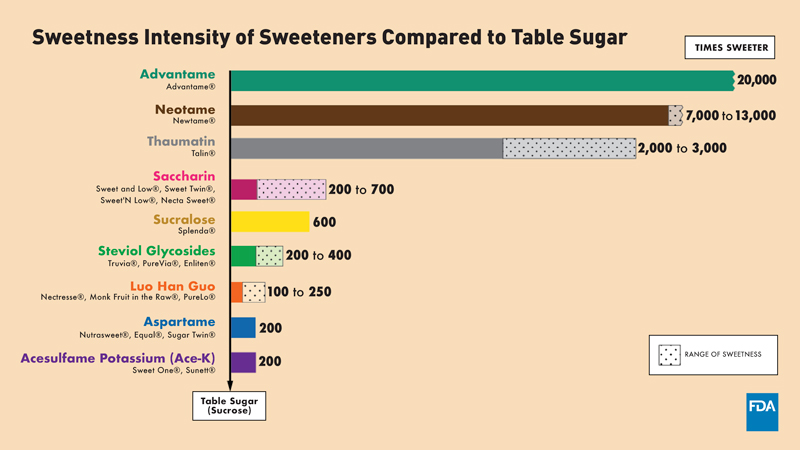
While usually assumed to be calorie-free, Aspartame does contain calories- however the quantities that are needed to achieve the sweetness effect often desired are usually so low that they’re negligible. For example, while aspartame contains the same amount of calories as table sugar (about 4kCal per gram), it is also 200x sweeter than sugar so a can of diet coke (200mg) would at most contain a single calorie. Compare that to a standard can of Coke with 39g of sugar, you can see the power of aspartame in reducing the number of calories in food. This makes it popular for reducing caloric intake/ dieting while still providing a “sugar fix”. (Note it does not appear that aspartame has the same satiating effect as nutritive foods- See citation below) .
After its approval in the U.S it also received the go-ahead in the EU. Like all foods in the U.S it was also given an ADI, or acceptable daily intake. The FDA sets the ADI of aspartame at 50mg per kilogram of body weight per day. You can use the calculator below to estimate how many drinks it would take for you to reach this limit. A common theme in most of the claims made against Aspartame are their reliance on studies that use supraphysiological doses (doses not realistically consumed or found in the human body), but human studies at realistic intake levels are more relevant for risk assessment. It will also be important to note that Aspartame, like most compounds metabolized in the body, break down into smaller products during digestion.
There are hundreds of studies on the effects of Aspartame in both animal and human studies and I won’t pretend to say I have read them all. What I can say is that the many MetaAnalysis I have read (many of which are cited in later sections) point to the same conclusion: that aspartame is nontoxic to humans at the recommended ADI. These, along with reports from health organizations like the FDA, WHO, ACS, etc, show that scientists as a whole, when reviewing all of the data present, see little to no correlation between aspartame and the supposed health consequences. There are however certain claims that have some validity however their risks have been dramatically overstated- below is my research on the most common claims I’ve seen.
Citations/Studies
| Citation | Study Type | Key Finding | Link |
|---|---|---|---|
| The Physiological effect of aspartame and satiety | Clinical Study | This study isn’t flawed per-se but the conclusions you can draw from it are limited. The biggest problem I see is the sample size of n=6 people. This does not create statistical power. Also this study Analyzes the mechanisms aspartame takes to influence hunger (CCk and GLP-1 namely) and does not take into account the psychological effects of sweetness, and this is addressed in the paper. | Open study |
Common Claims
Cancer Risk
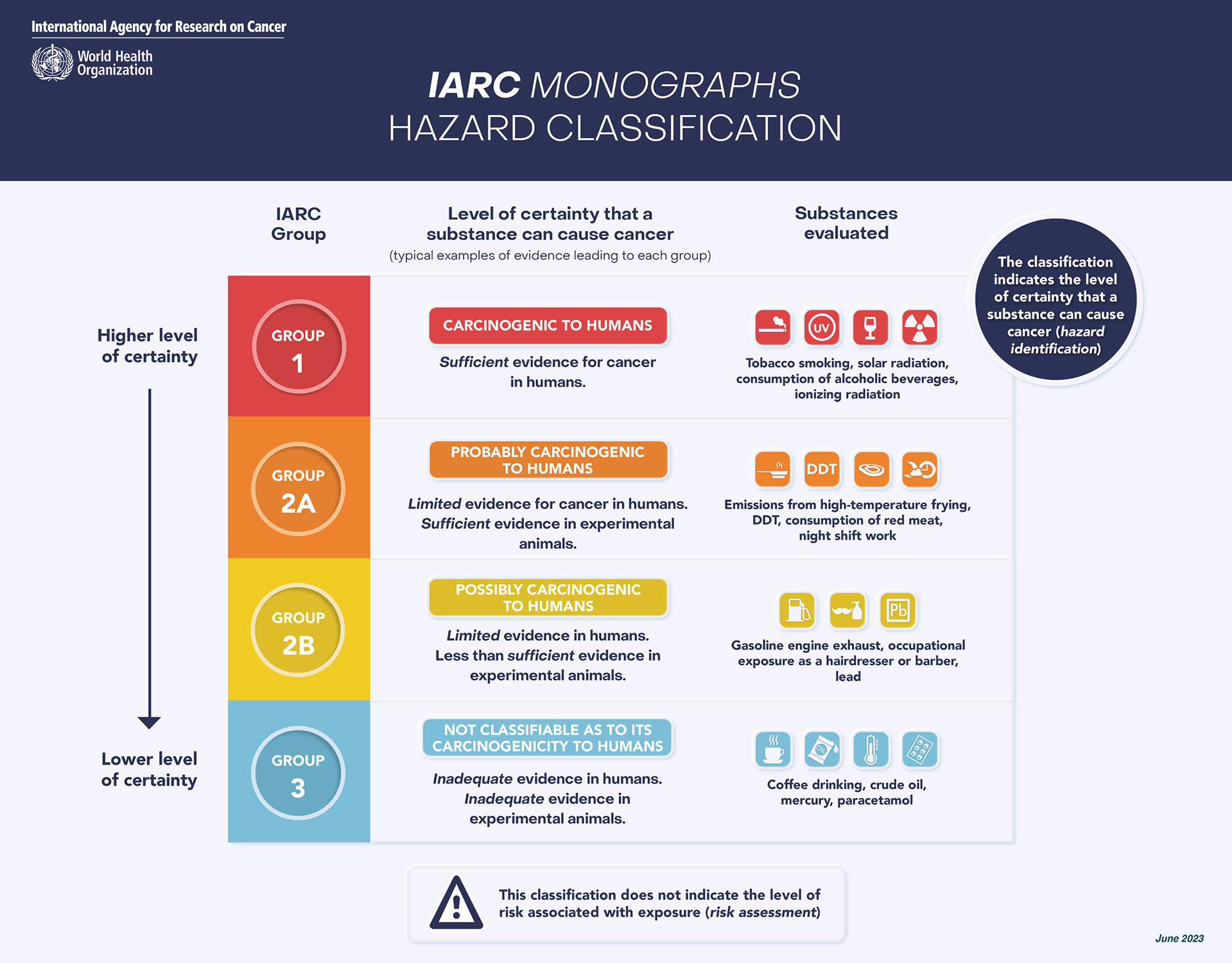
This claim became emboldened from the IARC after they classified Aspartame as a Group 2B Carcinogen. While this may sound scary, taken in the context of what this classification actually means, it really has no real bearing on health outcomes. Class 2B means that it is “possibly carcinogenic to humans”. This does not mean that it is, it just means there has been limited evidence to support this claim but more research is needed in humans. For reference, red meat is rated as a 2A carcinogen, meaning that it is “Probably carcinogenic to humans”.
The IARC does not have the power to enforce/ban substances and acts only to provide context to other organizations. After reviewing this new classification, the WHO, JECFA and the FDA did not change their ADI’s. In my personal opinion, the IARC does a poor job of informing the public on how to use this scale and leads to many false claims of substances being called carcinogenic when really they fall into groups like 2B and 3 and their certainty is very limited.
All this being said, the links to cancer were found in the bladders of rats- this is of note because we know that aspartame is broken down into its metabolites in the gastrointestinal tract, before it reaches the bladder (see section on toxic breakdown). This means that there is not a direct obvious relation between aspartame and bladder cancer. A study that is often cited in cancer claims is a rat study done in 2006/2007 showing the supposed link between cancer and aspartame. I’ve annotated my interpretation of the study in the Citations/Studies tab below. As a note, 14 other studies came to the opposite conclusion that aspartame did not have a carcinogenic effect.
With all of this, the FDA said it found issues with the IARC rating, even with it being at 2B, and did not update its stance or ADI on aspartame. Even the American Cancer Society has said that they do not see aspartame being a risk for causing cancer and although they are not a body that determines carcinogeny they have weighed the evidence from other organizations and as I have and come to the same conclusion.
Citations/Studies
| Citation | Study Type | Key Finding | Link |
|---|---|---|---|
| IARC’s report listing aspartame as a possible carcinogen | Report | Like stated above, other organizations have disagreed even with the classification by them of ““limited” evidence for cancer in experimental animals and “limited” mechanistic evidence.” | Open study |
| FAO/WHO Committee report | Report | This report shows that other health organizations found significant issues with IARC’s report and have made no recommendations to remove it from foods or change the ADI | Open study |
| Relationship between artificial sweeteners and cancer | Meta-Analysis | This is my favorite type of study- a meta-analysis takes a look at many other studies and quantitatively analyzes the results from all of them to come to a single conclusion. The conclusion from this one clearly shows no relationship between cancer between a number of artificial sweeteners, aspartame being one of them. | Open study |
| Safety Evaluation of Aspartame looking at multiple studies | Research Article | While I do agree with many of the points in the abstract (I’m not paying $67 to read the full version), this paper was funded entirely by an aspartame manufacturer so I hesitate to use its conclusions from other studies for this reason alone | Open study |
| The Sofretti Study of lifetime exposure to aspartame increasing cancer in rats | Rodent Study | I highly recommend you look at this study yourself; specifically the tables. This study is often cited when talking about aspartame being cancer causing. With 3 groups (Control, 2000ppm [equivalent to 100mg/kg] and 400ppm[equivalent to 20mg/kg], rats were tracked throughout their life and then autopsied to see if they had tumors.They state that while their lower-aspartame-group did not have a great statistical difference from their control group in lymphomas/leukemias/mammary carcinomas, especially when accounting for the overall incidence in their lab. Their lower group equivalent to 20mg/kg (Well within the FDA’s ADI) showed even less deviation from the control. While I agree that more evidence is needed, this study does not show any real correlation in my mind between aspartame and cancer | Open study |
| Sofretti Responds to Criticism | Article | I personally find this response to be vindictive and addresses many of his original works criticisms in a “They’re out to get me!” type of way. Overall I found their points to be fair but I think we just have a fundamental disagreement on the significance of their research. Of note they say they were disappointed to see the organizational bodies like WHO did not recommend the changes to ADI. The median group, which represented the 20mg/kg equivalent in humans (about half the FDA’s ADI), did not show a large statistical difference in cancer compared to the control. I fail to see why they would want these organizations to update their rating when the group within the FDA’s ADI did not develop cancer statistically higher. More research is needed and their findings were not enough to make changes or draw correlation-level conclusions. | Open study |
Neurological Effects
At this time, it does not appear there is good enough data to draw conclusions on this topic as research is complex and limited, at least for long-term effects. A common claim that aspartame causes acute reactions like headaches or even seizures has little, if any, scientific backing and all the papers I looked at showed no increased risk for either.
It should be noted a lot of these studies are looking at phenylalanine in the blood as well. While this might sound scary, this is just an essential amino acid.The reason they are testing for this specifically is because phenylalanine in high doses has been noted to cause irritability and anxiety in high doses. These reports do see an increase in this amino acid but not in a level that would likely cause these symptoms and noting that the recommended daily limit of phenylalanine in adults is magnitudes higher than any aspartame intake possible. See the Toxic Breakdown section for more on phenylalanine and the exception for people with PKU.
Citations/Studies
| Citation | Study Type | Key Finding | Link |
|---|---|---|---|
| Aspartame’s neurological effects | Systematic Review | This is a great systematic review looking over a number of studies related to the neurological effects. There are not many solid conclusions you can draw as many of the studies looked at are contradicted by others- “with some reporting negative impacts on cognitive and psychological outcomes, while others did not find significant effects”. For specific concerns I would recommend looking at this paper’s summarized conclusions on pages 8 & 9. Many of these studies look at population-specific results (i.e. kids) where results generally differed than those in adults. I think this highlights the need for further research as these discrepancies are not explainable right now. | Open study |
| Neuropsychologic and neurophysiologic evaluation of acute and chronic effects | Clinical Study | This is a general study on a number of neurological components often associated negatively with aspartame. The conclusion drawn is that aspartame did not have any negative effects saying that “Given all of the above and our own findings, we are skeptical about recent claims that aspartame may be related to self-reported neuropsychologic and neurologic symptoms”. | Open study |
| Aspartame and Seizures | Clinical Study | I hate to include just an abstract in my citations but this one seems to have enough information to have some value without seeing the full paper. Although the n is rather low, the population quality seems of quality (people reporting to have seizures related to aspartame) and it being a double-blind randomized study gives it some merit. Its conclusion is that in the ADI bounds, aspartame seems to have no effect on seizures compared to the control group. | Open study |
Weight Gain
If anything, from the studies I have read, the opposite tends to be true. Lowering caloric intake while maintaining or increasing energy expenditure is the primary driver of weight loss. By using a low-calorie sweetener, you replace a higher-calorie counterpart, and assuming it is substituted rather than added, total caloric intake would generally be lower in that scenario.
That being said, there is a psychological and behavioral component to consider. If aspartame were to increase cravings or lead to compensatory eating compared to the high-calorie alternative, then its net effect on weight could be reduced or even negated. The research I have reviewed does not consistently support this outcome, though results are somewhat mixed.
It is also important to distinguish between study types. Controlled trials, where aspartame replaces sugar, generally show neutral or modestly beneficial effects on body weight. Observational studies sometimes report associations between artificial sweetener use and weight gain, but these findings are likely influenced by confounding factors, such as individuals already attempting to lose weight being more likely to consume diet products.
Overall, the current evidence suggests that aspartame does not inherently cause weight gain. When used in place of higher-calorie sweeteners, it can help reduce total energy intake, though real-world outcomes depend on broader dietary habits and individual behavior.
Citations/Studies
| Citation | Study Type | Key Finding | Link |
|---|---|---|---|
| Sucrose compared with artificial sweeteners on human body weight | Research Study | This is definitely not a perfect study (low n, short time frame, study getting older) but it helps dispel the claim that aspartame causes weight gain. In this case it reduced total fat mass slightly. | Open study |
| Effectiveness of aspartame in helping with weight control | Research Review | This review combines the learnings of several metanalyses to reach the conclusion that aspartame has helped with reducing total calorie intake in humans. It states that the rate of weight loss associated with aspartame (and other low-calorie sweeteners) compared to traditional sweeteners is “low but meaningful” | Open study |
| Long term effects of aspartame on weight gain and other things | Research Study | This study takes a look at three things, one of which being weight gain. I’ve included it mainly because it takes into account long-term effects rather than shorter studies. It concludes that it found a beneficial effect of consuming aspartame (as it relates to body weight) and the other metrics it looked at, which are beyond the scope of this section, were found to be not problematic and “ A neurotoxic effect of aspartate is, however, poorly supported by our results” and more research would be needed. | Open study |
Effects on the Microbiome
While there is some evidence to suggest that aspartame has an effect on the microbiome, the research done thus far has not been conclusive. There is strong evidence that aspartame can alter the microbiome, but the clinical significance of these changes remains unclear. Most studies otherwise show mixed results, some even being positive, or contradict other findings. The studies that do show negative results are minor and mainly have to do with a heightened glycemic response. This does not make it cause an insulin spike but rather that it may have an indirect effect on insulin sensitivity long-term.
Citations/Studies
| Citation | Study Type | Key Finding | Link |
|---|---|---|---|
| Microbiome effects following the use of non-nutritive sweeteners | Clinical Study | This is probably the highest quality study done on NNS on the microbiome. What can be concluded from this, specifically in relation to aspartame, is that it is not biologically inert and does have an effect on the microbiome but that these effects are yet to be determined in any meaningful way. Just because it is changing something does not make it inherently bad. This study also highlights the individuality of aspartame with some people having no changes in glycemic response and microbiome and others having both. As stated many times here,“ We stress that these results should not be interpreted as calling for consumption of sugar , which is strongly linked to cardiometabolic diseases and other adverse health effects”. | Open study |
| Effects on the microbiome | Clinical Study | Although the population of this study was low, it seems to otherwise be a good study and concluding that realistic intake of aspartame in healthy adults had no measurable effect on the microbiome of participants. | Open study |
| Aspartame consumption / Gastrointestinal health review | Systematic review | This study takes a look at 7 other studies done relating to the gastrointestinal effects of aspartame. It concludes that there have been findings of concern that require more research and that “Large-scale and longitudinal human trials are urgently needed to explore dose-dependent effects of aspartame”. In my opinion, the studies that were done that had negative outcomes had negative findings that were minimal. The negative effects of aspartame compared to the high-calorie alternative are not worth the switch back. Overall this review is a good impartial look at current microbiome research and I recommend you take a look at the table in the review and judge the claims and their limitations for yourself. | Open study |
Toxic Breakdown
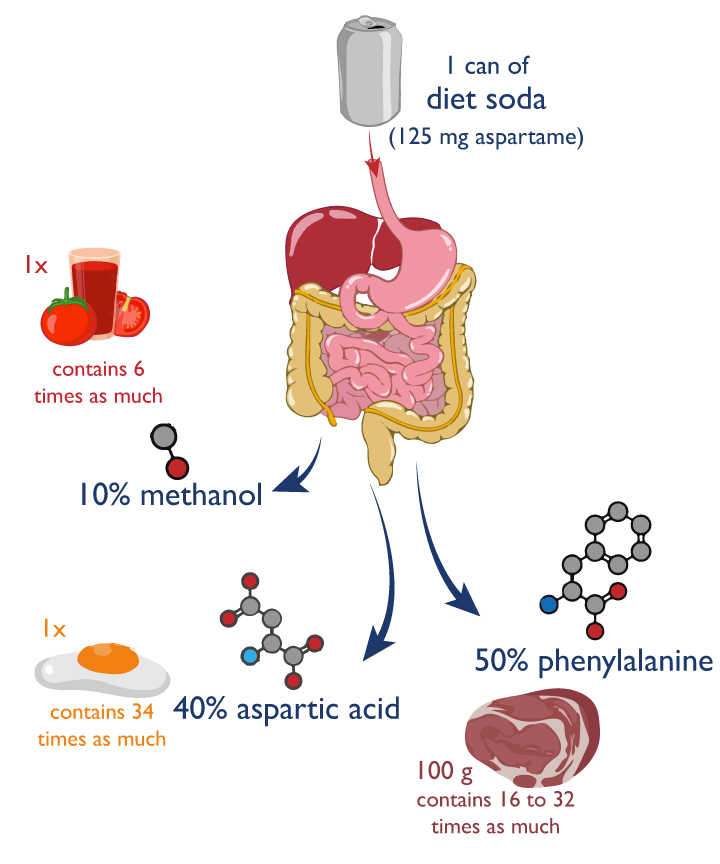
As noted in the overview, aspartame breaks down into smaller pieces when it enters the gastrointestinal tract. It breaks down into three main metabolites: methanol, aspartic acid, and phenylalanine. While these may sound scary, these are common in everyday foods and two of them are amino acids; the basic building blocks for proteins in our body.
Methanol is also produced by the body in small amounts. While it is just the byproduct of gut bacteria your body is well equipped to remove it from the body and the amount consumed through even 50x the ADI is still 100x lower than what is needed to see any negative effects. Foods like fruits and vegetables, especially their juice counterparts, contain a similar or higher doses of methanol than that found in a can or diet soda.
I want to give special note to this phenylalanine however as there is a risk to people with phenylketonuria (PKU). This disorder affects a very small number of people and is inherited at birth; this is not something you would not know about as an adult as all newborns in the U.S. are screened for this at birth. To these people phenylalanine is toxic and can be fatal
Citations/Studies
| Citation | Study Type | Key Finding | Link |
|---|---|---|---|
| NZ Medical Journal: Facts and Fictions of Aspartame | Medical Journal | This article goes over many of the talking points of aspartame and does a good job of debunking many of them. While I agree with everything in it, I didn’t use it as a source as it is self-reported that it was funded by coca-cola, a company that has a financial interest in aspartame’s governmental and social acceptance. Also his first reference was also funded by a similar industry. This being said, just because a paper is funded by a corporation with financial interest does not make all of its findings moot- I just want to note it. | Open study |
| Safety Analysis of Aspartame | Narrative Review | This paper analyzes a lot of the claims made against aspartame but in this case just go to the section on Genotoxicity. Reading it, you’ll see conflicting paragraphs; a good sign of impartial writing in my opinion as the author presents both sides. Looking at the sources provided for, some of these studies are really moot and provide poor evidence against. For example reference 82 is a paper on the In vitro study of a drug used for diabetes and number of artificial sweeteners and it concluded that there may be a fragmentation of DNA. First, see my article on my thoughts on In Vitro Studies. Also consider that they used multiple sweeteners and specifically on its interaction with DNA and another drug which was already causing mutagenetic effects. The point here is that when looking at the sources on both sides of this review one side seems more credible than the other. | Open study |